About 5 years ago, JAXA’s Hayabusa2 spacecraft successfully completed its primary mission to explore Asteroid 162173 Ryugu. In June 2018 it achieved a rendezvous with the asteroid, and subsequently conducted an 18 month close-up study, including collecting rock samples from Ryugu’s surface. The spacecraft then left Ryugu, journeyed back, and dropped off its samples to Earth in December 2020.
The Hayabusa2 space vehicle was then redeployed on an extended mission – designated Hayabusa2# – its first port of call to perform a fly-by of Asteroid 2001 CC21, now named Torifune, in July 2026.
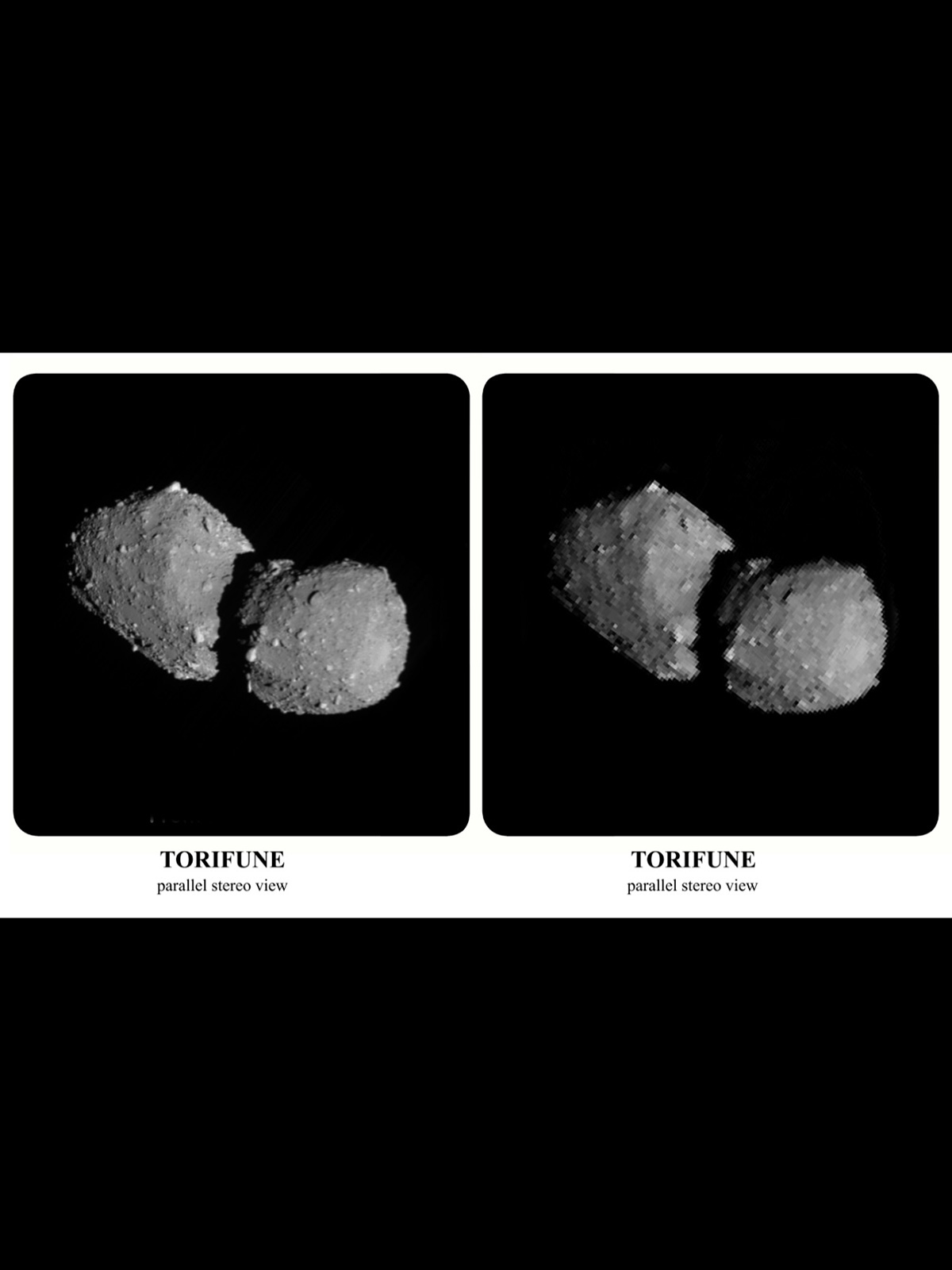
The brief encounter, successfully negotiated just a couple of weeks ago, revealed a beautiful contact binary, about 450 metres long. A handful of images were captured using the onboard Optical Navigation Camera – Telescopic (ONC–T), as the probe sped past at around 100,000 miles per hour, only half a mile (800 metres) from the asteroid at the closest approach – a very risky operation !
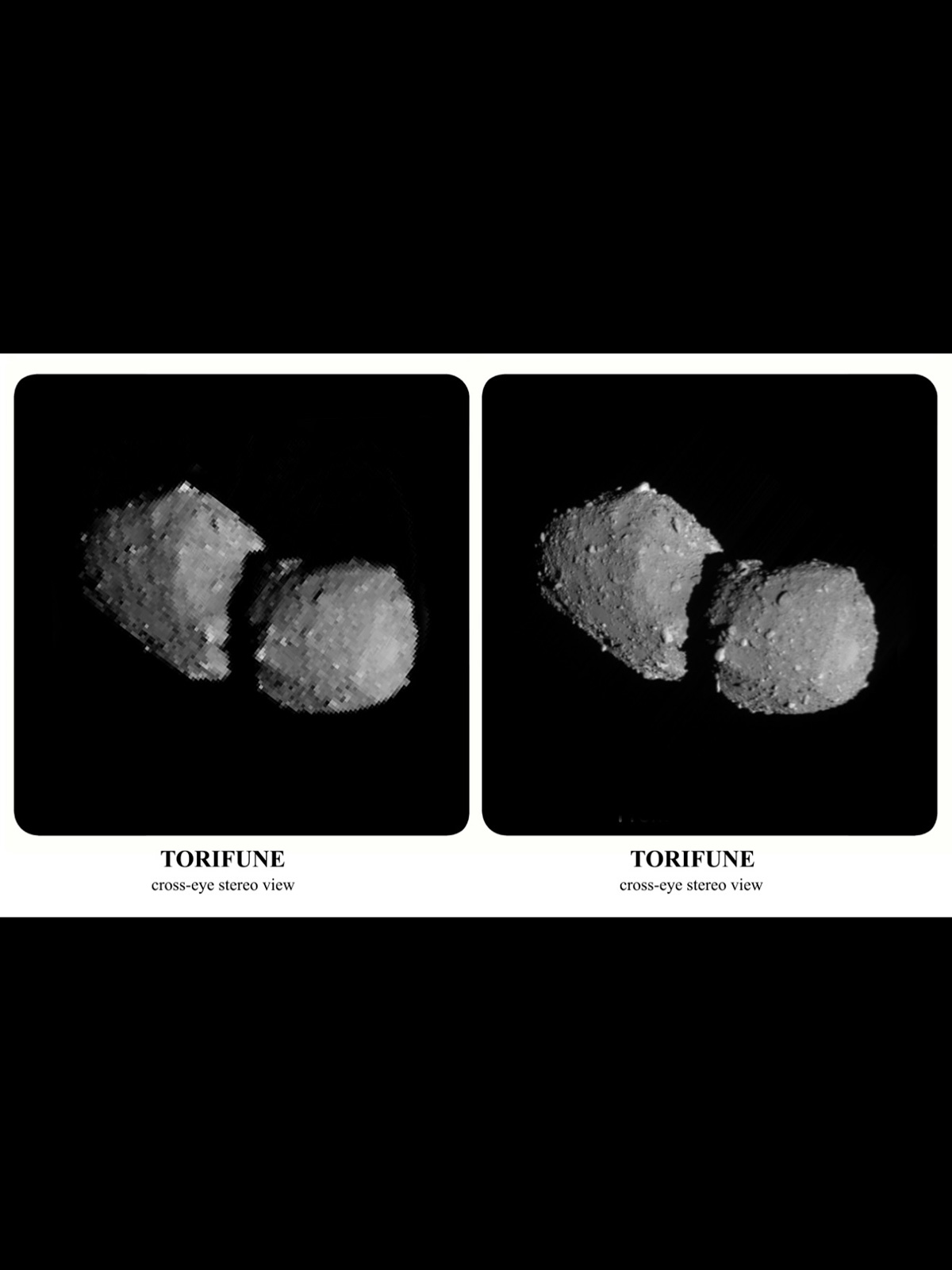
Using the parallax generated by the probe’s oblique path relative to the asteroid, we were able to make this stereo pair – providing possibly the only viable stereoscopic image of Torifune that will ever be seen by humans.
It should be noted that the right hand image of this pair (in the parallel configuration) was captured from a greater distance than the left, and so suffers more pixellation.
Congratulations to the Hayabusa2# team ! Special thanks to Patrick Michel of ESA, and Makoto Yoshikawa of JAXA for access to these precious data.
Hayabusa2#’s next encounter is planned to be with asteroid 1998KY26 in 2031. See you there !
Brian May and Claudia Manzoni
View on Instagram